
ABOUT THIS QUALIFICATION
This qualification reflects the role of an individual working as a senior civil works designer or a para-professional designer, who supports professional engineers. They perform tasks that are broad, specialised, complex and technical and include strategic areas and initiating activities. They are responsible for the design of complex projects to ensure the implementation of the client’s site requirements and are required to demonstrate self-directed application of theoretical and technical knowledge and initiate solutions to technical problems or management requirements

Students are provided with advice on employment and training options throughout the delivery of the program. After achieving the RII60520 Advanced Diploma Of Civil Construction Design, candidates may choose to undertake Bachelor of Engineering (Civil).




Course Fees
| Course Fees | $26000 | Unit Repeat cost | $350 |
| Deferment Fee | $500 | Re-assessment | $350 |
| Application Fees | $300 | Replacement Student ID | $15 |
| RPL Fees | $150/Unit | Credit Transfer | $0 |
| Certificate Re-issue Fees | $200 | Student Photocopying | 10c/page |
| Material Fees | $1300 | Airport pick-up | $100 |
| Change of CoE | $300 | Estimated Total Course Cost | $27,500 |
Note: Please refer student handbook and refund policy for further information
UNITS OF COMPETENCY
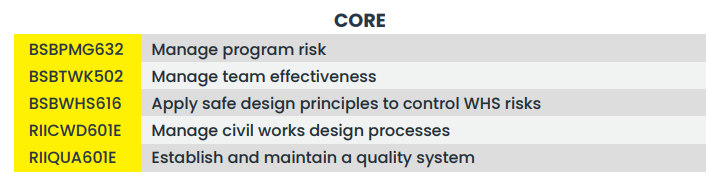
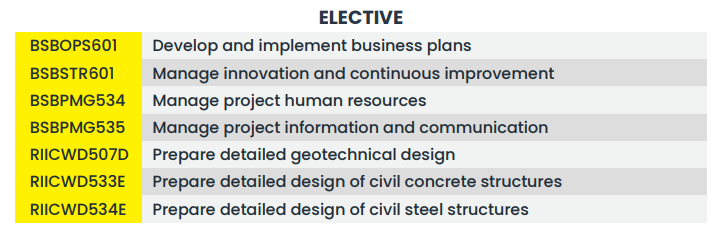

Quality Assurance : As a registered training organisation (RTO), the Institute operates within the Vocational Education and Training Quality Framework (VETQF) and the Australian Qualifications Framework (AQF) delivering nationally recognised qualifications and Units of Competency.
ADMISSION REQUIREMENTS
The RII60520 Advanced diploma in civil and construction design allows direct entry into this qualification at the time of publication in training.gov.au. However, the RTO requires candidates to meet its admission requirements prior to enrolling into this qualification to ensure that they have the required skills and knowledge to successfully complete the qualification at this AQF level. This consists of:
(According to the RTO)
1.
| IELTS (General or Academic) overall | PTE Academic | TOEFL IBT | CAE Scale |
|---|---|---|---|
| 6.0 | 47-54 | 60–78 | 169-175 |
- Minimum age of 18 years and above
- Satisfactory completion of the equivalent of Australian AQF level 4 or higher
Note: Results older than two years are not acceptable (for offshore applicants)
OR
2. Evidence that they have studied in English for at least five years in Australia, Canada, New Zealand, Republic of Ireland, South Africa, United Kingdom or United States.
OR
3. Evidence that, within two years of their application date, they have successfully completed in Australia a foundation course or a senior secondary certificate of education or successfully completed substantial components (50% or more units according to the training package) of a Certificate IV qualification or higher level qualification from the Australian Qualifications Framework on a Student Visa.
OR
4. Applicants who do not provide a valid IELTS or equivalent English language test result may undertake the Oxford Placement Test (OPT) administered by Kangaroo International College. Applicants must achieve a minimum score of 61 (CEFR B2 level or equivalent) to satisfy the College’s English language entry requirement. The completed Oxford Placement Test report will be retained on the student’s file as evidence that the applicant has met Kangaroo International College’s English language entry requirements.
International Students (onshore and offshore)
All international students are required to complete a Pre-Training Review, including an LLND assessment, to identify individual training needs. This process evaluates the learner’s previous education or training, relevant work experience, and the suitability and relevance of the course to their learning goals. This assessment may be conducted via video call or phone call for both onshore and offshore students.
Other Conditions
Students are expected to dedicate approximately 10 hours per week to guided learning during the training weeks, excluding term breaks.